
At least 20 Indian soldiers were killed in the violent face-off, government sources said and added that the casualty numbers could rise.

Lt Gen Dwivedi, who was referring to the clash between the Indian soldiers and Chinese troops in the Galwan Valley in June 2020, also said that PLA's aggression in eastern Ladakh was met with "swift mobilisation and appropriate force posturing".

India has over 4,000 medium tanks, but not a single light tank. It remains to be seen whether the Ladakh face-off with China galvanises a change, observes Ajai Shukla.
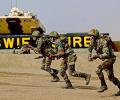
The Indian Army's broader reorganisation is inevitable as India's military doctrine adapts to the demands of the modern battlefield.

After India firmly told China that its violation of the border pacts has "eroded" the entire basis of bilateral ties, China's defence ministry on Friday said the situation at the border is "generally stable" and both sides should put the boundary issue in an "appropriate position" and promote its transition to "normalised management".

Giving an account of India's overall military modernisation, Lt Gen Pande also said that an in-principle approval has been given to new combat formations called the Integrated Battle Groups (IBGs) which can mobilise fast with a more effective approach.

India has not yet received any confirmation on Chinese President Xi Jinping's in-person participation at the upcoming G20 summit, people familiar with the matter said on Thursday amid reports that he is likely skip the conclave.

Chinese Foreign Minister Qin Gang reiterated that the situation at the India-China border is generally stable and both sides should consolidate the present achievements and strictly abide by the relevant agreements while pushing for further cooling and easing of the conditions for sustainable peace and tranquillity at the frontier.
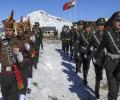
Responding to Conservative Party MP Flick Drummond on the implications for British interests of a dispute between a 'Commonwealth member and the world's largest democracy on the one side, and a state that challenges our notion of democracy on the other,' he described the escalation in eastern Ladakh as "a very serious and worrying situation", which the UK is "monitoring closely".
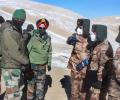
Lou also spoke about China's tensions with neighbouring countries without directly mentioning the eastern Ladakh border standoff with India since May 2020 which resulted in the Galwan Valley clash in June of that year.
It has been argued that India should have held back on disengagement from the Kailash Range, using that as a trump card to force Chinese concessions in areas such as Depsang, where they hold the advantage.

On the first anniversary of the deadly clashes, the army said the supreme sacrifice of the soldiers while fighting the adversary in the "most difficult" high altitude terrain will be "eternally etched" in the memory of the nation.
India on Monday announced it has reached an agreement with China on patrolling along the Line of Actual Control (LAC) in eastern Ladakh, in a major breakthrough in ending the over four-year-long military standoff ahead of a likely meeting between Prime Minister Narendra Modi and Chinese President Xi Jinping in Russia this week.
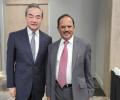
Doval is in Beijing for the 23rd round of the Special Representatives' talks being held after a gap of five years.

Military experts said the aim of constructing the bridge in the Khurnak area could be to ensure that the Chinese People's Liberation Army is able to quickly mobilise its troops in the region.

India on Tuesday lodged a strong protest with China over its so called 'standard map' laying claim over Arunachal Pradesh and the Aksai Chin, and asserted that such steps only complicate the resolution of the boundary question.

'The Government of India should start a dialogue with the people of Ladakh, but the trouble is they are not willing to listen to our grievances.'

His comments came in the midst of India's bitter border row with China along the LAC in eastern Ladakh.

'We should not allow ourselves to be surprised in any manner in future on the border.'

The conclave will be held at the national capital from April 18-22 and will be chaired by Army Chief Gen MM Naravane.
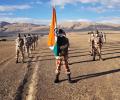
India and China on Friday agreed to hold the next round of military talks at an early date to achieve the objective of complete disengagement in remaining friction points in eastern Ladakh amid fresh sparring between the two sides on the prolonged Line of Actual Control (LAC) standoff.

The Budget Session of Parliament will begin on Monday with the address by President Ram Nath Kovind to both Houses in the Central Hall.

Jaishankar described as a "reasonable supposition" to expect some improvement in the relations between India and China following the last round of disengagement but hesitated to say that there could be a reset of the ties.

Prime Minister Narendra Modi's bilateral meetings on the sidelines of the BRICS summit in Johannesburg are being finalised, Foreign Secretary Vinay Kwatra said on Monday but did not give a direct reply on the possibility of a meeting between Modi and Chinese President Xi Jinping.

At a media briefing, External Affairs Ministry Spokesperson Arindam Bagchi said India monitors such developments.

Defence Minister Rajnath Singh on Thursday held talks with his Chinese counterpart Li Shangfu and is learnt to have discussed the lingering border row in eastern Ladakh.

The remarks of White House Press Secretary Jen Psaki came ahead of the 14th round of military-level talks between India and China on the 20-month row in eastern Ladakh.

With the two armies again in a face-off at multiple points, there is apprehension of renewed clashes.

Lt Gen PGK Menon, the commander of the Leh-based 14 Corps, popularly known as 'Fire and Fury' Corps, briefed the army chief on various aspects of the situation in eastern Ladakh.

Lauding the bravery displayed by the soldiers, the prime minister said: "The bravery that you and your compatriots showed, a message has gone to the world about India's strength."

The transgression took place on August 30, and the Chinese troops returned from the area after spending few hours, they said.
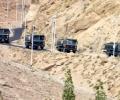
The CSG is one of the topmost bodies in the government which provides directions to the military and diplomats on the stand to be taken during talks with the Chinese and also take a stand on the points and demands raised by the Chinese side.
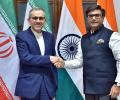
India's Foreign Secretary Vikram Misri will travel to Beijing for a two-day trip beginning Sunday, marking the second high-profile visit from India to China in less than one-and-a-half months. The visit comes amidst ongoing border tensions and follows a recent disengagement pact between the two countries in eastern Ladakh. The Foreign Secretary-Vice Minister mechanism meeting will focus on the next steps for India-China relations, including in the political, economic, and people-to-people domains. The decision to revive this bilateral mechanism was taken at a meeting between Prime Minister Narendra Modi and Chinese President Xi Jinping in Kazan in October.
"India and China to hold Corps Commander-level talks on October 12 in the Eastern Ladakh sector to address the ongoing military standoff between the two countries. So far, the two sides have held six rounds of Corps Commander-level talks," the source said.

The names of 20 Indian Army personnel, who were killed while valiantly fighting Chinese troops in Galwan Valley in eastern Ladakh in June last year, were inscribed on the National War Memorial ahead of the Republic Day, official sources said.

The last round of Corps Commander-level talks had taken place on October 12 but there was no breakthrough on the disengagement of troops from the friction points.
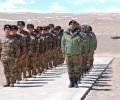
The fresh round of Corps Commander talks are scheduled to start at 10:30 AM at Moldo border point on the Chinese side of the Line of Actual Control in eastern Ladakh, they added.
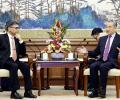
India and China have agreed to rebuild ties and resume people-to-people exchanges, including resuming direct flights and the Kailash Manasarovar Yatra this year. The two countries also discussed the resumption of dialogue mechanisms to address each other's concerns and move relations to a more stable path. The meeting comes after a period of strained relations following the Galwan Valley clashes in 2020.

On Wednesday, Richa had reacted to Northern Army Commander Lt General Upendra Dwivedi's statement that the Indian Army is ready to execute orders like taking back Pakistan-occupied Kashmir.
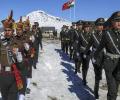
Sources said India will not lower its guard and will maintain the current state of very high-level of combat readiness in eastern Ladakh till there are visible changes in the ground situation.
